Analyzing User-Defined Functions (UDFs) in SQL Server is often a tedious, manual process that slows down development and increases the risk of system errors. As database schemas grow in complexity, understanding the logic, dependencies, and data manipulation within these functions becomes a critical challenge for DBAs and developers alike. DBInsights Solve this by using AI-driven automation to provide instant, transparent, and comprehensive function analysis.
What is SQL Server Function Analysis?
SQL Server function analysis is the process of examining User-Defined Functions (UDFs) to understand their logic, performance impact, and dependencies within a database. Effective analysis ensures that functions return correct data types, execute efficiently, and do not break downstream processes like stored procedures or reports.
Traditional analysis requires manual scripts or “Sp_helptext” commands, which fail to show the bigger picture. DBInsights modernizes this by surfacing deep metadata insights, allowing teams to audit code without getting lost in thousands of lines of T-SQL.
How DBInsights Simplifies Function Analysis
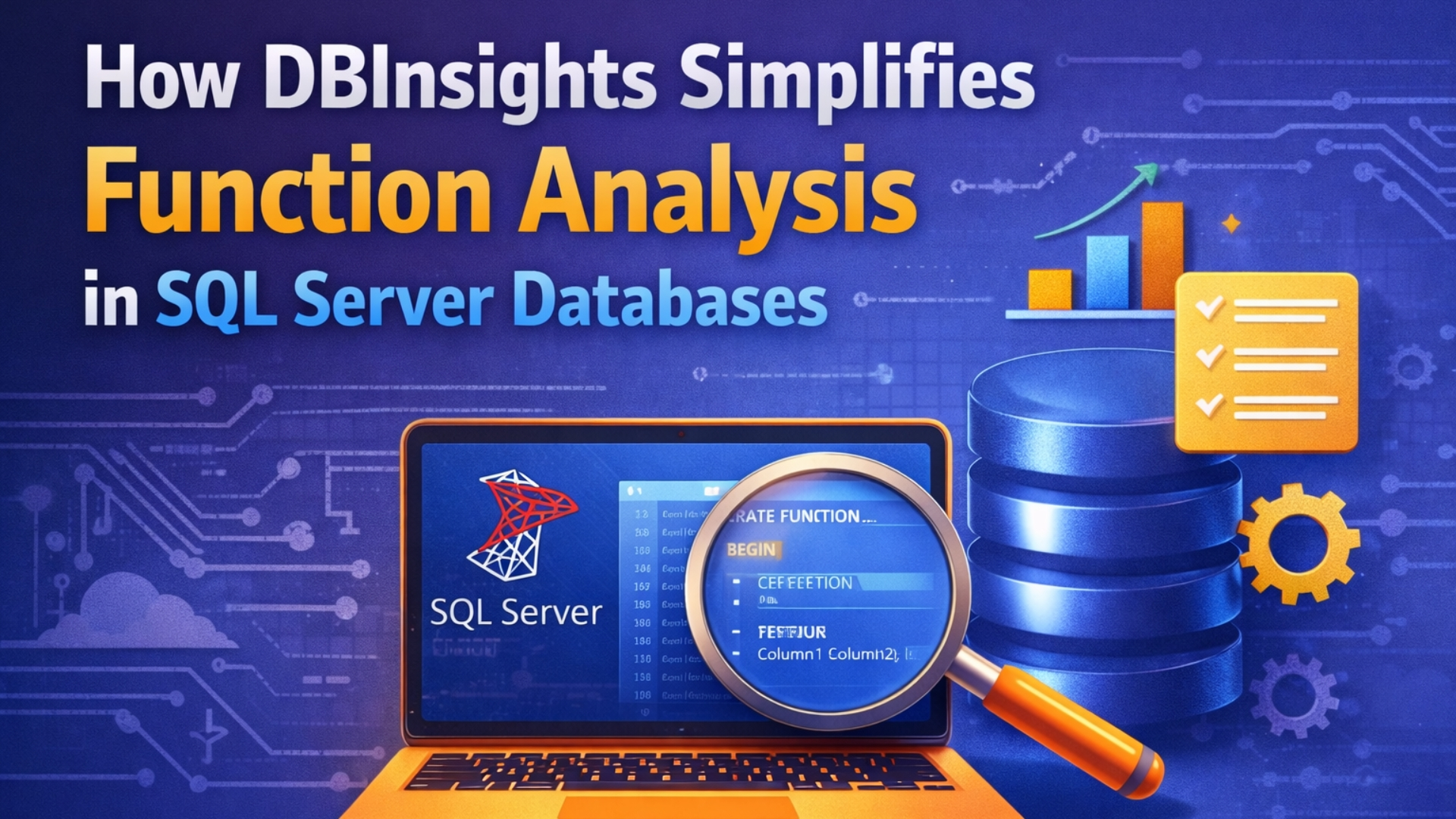
DBInsights simplifies function analysis by using LLM technology to automatically document, map, and summarize every function in your SQL Server environment. Instead of manual tracing, the platform provides a centralized portal where technical and non-technical users can see exactly how data flows through any given function.
1. AI-Generated Functional Descriptions
One of the biggest hurdles in database management is legacy code without comments. DBInsights uses AI to generate clear, plain-English summaries of what each function does. This eliminates the “discovery phase” for developers, allowing them to understand complex logic in seconds rather than hours.
2. Automated Dependency Mapping
Functions rarely exist in isolation. A single change to a scalar or table-valued function can cause a ripple effect across your entire schema. DBInsights provides:
- One-click visibility into related tables, views, and stored procedures.
- Implicit relationship detection that traditional SQL tools often miss.
- Impact analysis to prevent breaking changes during deployments.
3. Code Transparency and T-SQL Visibility
While AI provides the summary, developers still need to see the raw logic. DBInsights displays the full T-SQL definition alongside the analysis. This dual-view approach ensures “Code Transparency,” making it easier to troubleshoot bugs or perform security audits without leaving the dashboard.
Key Benefits of AI-Powered Function Analysis
Moving from manual documentation to an AI-powered workflow like DBInsights offers measurable operational advantages:
- Reduced Development Time: Save 2–3 hours per project by eliminating manual dependency tracing.
- Faster Onboarding: New team members can understand the database “brain” through AI summaries rather than tribal knowledge.
- Improved Accuracy: Minimize human error by using automated scans that stay synchronized with your live database.
- Complete Visibility: Gain a “single source of truth” for all database objects, ensuring nothing is hidden in complex schemas.
Why DBInsights is the Best Tool for SQL Function Analysis
DBInsights is purpose-built for SQL Server environments where security and speed are paramount. Unlike tools that require access to your actual data records, DBInsights operates solely on metadata. This ensures your sensitive information remains private while still providing the deep architectural insights needed to maintain a high-performance database.
By automating the documentation of schemas, functions, and stored procedures, DBInsights transforms database management from a reactive chore into a proactive strategy.
FAQs
How does DBInsights handle complex T-SQL function logic?
DBInsights uses advanced Large Language Models (LLMs) to parse the T-SQL code within database functions. It generates clear natural language summaries that explain the underlying data transformations, conditions, and business logic applied in the function.
Can I see which tables a function depends on?
Yes. DBInsights provides automated relationship mapping that identifies every table, view, or stored procedure referenced by a function. This includes indirect or hidden dependencies that are not explicitly defined through foreign key relationships.
Does DBInsights require access to sensitive database records?
No. DBInsights analyzes only database metadata such as schemas, object definitions, and structural relationships. Actual data records are never accessed, processed, or stored, ensuring strong security and compliance.
How does this tool help with SQL Server auditing?
DBInsights supports SQL Server auditing by maintaining up-to-date technical documentation and providing clear visibility into T-SQL definitions, permissions, and data lineage. This enables auditors to review database logic and access controls efficiently across the entire environment.